

AI labeling requirement 2026: what applies to social media?
Since August 2, 2026, Art. 50 of the EU AI Act applies: businesses must disclose realistic-looking AI images, videos and audio (deepfakes). There is no duty to label every AI image.
Not legal advice
Legal status: October 13, 2026. This article explains general obligations under EU and German law and is not legal advice. For your individual case, contact a lawyer, your Chamber of Commerce and Industry (IHK) or your Chamber of Crafts (Handwerkskammer). The rules on AI labeling are new and are still being interpreted. This article is therefore reviewed every three months. For questions about the AI Act, the AI Service Desk of the Federal Network Agency (Bundesnetzagentur) helps small businesses. The sources are listed at the end.
What has applied since August 2, 2026?
Since August 2, 2026, Art. 50 of the AI Act (Regulation (EU) 2024/1689) has applied. It sets transparency obligations for AI systems. The European Commission confirms this on its fact page (last updated July 29, 2026). The Digital Omnibus (Regulation (EU) 2026/1744, in force since July 27, 2026) created only a transition period for providers under Art. 50. It does not concern the business that uses AI but the provider of the tool (see below).
Important: there is no duty to label every AI image. The duty applies to realistic-looking content that appears real but isn’t.
Provider or deployer: what applies to you?
The regulation distinguishes two roles. Your business is usually a deployer.
| Role | Who that is | Duty | Transition period |
|---|---|---|---|
| Provider | Whoever offers an AI system that creates images, video, audio or text – in other words, the AI tool. | Must mark outputs in a machine-readable way as AI-generated (Art. 50 (2)). | Until December 2, 2026, but only for generative systems that were already on the market before August 2, 2026 (Digital Omnibus). |
| Deployer | Whoever uses an AI system professionally and publishes the results – in other words, your business. | Must disclose deepfakes. Also texts on matters of public interest if no human reviews them editorially and takes responsibility for them (Art. 50 (4)). | None. The duties have applied since August 2, 2026. |
Purely private, non-professional use is not covered. The business profile of your salon, your restaurant or your trade business is.
What is a deepfake?
Under Art. 3 (60), deepfakes are AI-generated or AI-manipulated image, audio or video content that resembles existing persons, objects, places, entities or events and would falsely appear to a person to be authentic or truthful.
According to summaries of the European Commission’s guidelines, obviously fantastical or physically impossible content is not covered. For recognizably artistic, satirical or fictional works, a restrained notice is enough. The Commission is working on guidelines on Art. 50. Summaries of them are the basis for this classification.
Which images do you have to label?
Ask yourself for every AI image: does it look like a real photograph of real people, places, products or events, or of your business? Then it is probably a deepfake and must be disclosed.
| Image | Label? | Why |
|---|---|---|
| Product photo, only retouched (color, brightness, dust removed) | Usually no | The photo still shows the real product. YouTube explicitly excludes small changes such as color correction. |
| Real product in front of an AI background | Recommended | The background can look like a real place. When in doubt, label. |
| Photorealistic AI scene with people, for example “guests” in your venue | Yes | Looks like a real photograph. |
| AI team photo or AI “employees” in a recruiting post | Yes | Looks like a real photograph of your team. |
| Photorealistic AI image of a “finished bathroom” or a dish | Yes | Appears to show real work. It can also be misleading (see the note below). |
| Illustration, comic or graphic made of type, shapes and colors | Usually no | Doesn’t look like a real photograph. |
| Obviously fantastical scene, such as a coffee cup with a cloud city | Usually no | Obviously not real. |
| Caption that core wrote and you reviewed and approved | Usually no | See the next section. |
No invented results
AI images that fake real work can be misleading under competition law, even with an AI label. That applies to before-and-after images at the hairdresser, dishes that are never served like that, and work your business never did. This is an assessment based on the general ban on misleading practices (§ 5 UWG, Germany’s Unfair Competition Act), not a ruling on AI images.
Do AI texts have to be labeled?
As a rule, no. An ordinary marketing caption that a human reviews and approves needs no AI notice. Deployers only have to disclose AI texts if they inform the public about matters of public interest and no human has editorially reviewed the text and taken responsibility for it (Art. 50 (4)). A post about opening hours, offers or your latest project does not usually fall under this.
The exception only applies if the review really takes place. Read the text before you approve it.
What do the platforms require in addition?
Regardless of the law, the platforms have their own rules. They add to the legal duty but don’t replace it.
| Platform | Requirement according to the platform | Label and source |
|---|---|---|
| Instagram and Facebook (Meta) | Disclosure is mandatory for photorealistic video or realistic-sounding audio that was digitally created or altered. Violations can lead to penalties. | “AI info” label. Images are labeled, too, if Meta detects industry signals in the file or you state it yourself. Source: Meta Newsroom, April 5, 2024, updates through September 12, 2024. According to onlinemarketing.de (July 17, 2026), Meta first rolled out the label on the post on iOS in 2026. |
| TikTok | Labeling is mandatory for realistic AI images, audio and video. Without a label, removal, restriction or a label applied by TikTok can follow. | Switch when posting. Content from TikTok’s own AI effects and with Content Credentials is labeled automatically by TikTok; these labels can’t be removed. Sources: TikTok Newsroom, May 9, 2024, and TikTok’s Community Guidelines (Integrity & Authenticity). |
| YouTube and Shorts | Disclosure is mandatory for realistic content: a real person says or does something that never happened, altered footage of real events or places, realistic invented scenes. Excluded are unrealistic content, small changes such as beauty filters or color correction, and AI help with script, title or ideas. | Declaration when uploading in YouTube Studio. YouTube sets the label, in the player for photorealistic content. Without disclosure, YouTube can set a label itself or remove the content. Source: YouTube Help. |
| No separate disclosure duty could be found. | According to a third-party source (MediaPost, May 2024), LinkedIn shows an automatic label if Content Credentials are embedded in the file. An official LinkedIn help article on this could not be found. |
Platform rules change often. Before a post, read the current version at the source; the links are under “Sources”.
How to label correctly
- Check the image. Is it photorealistic, and does it seemingly show real people, places, products, events or your business? Then you disclose it.
- Turn on the platform label where the platform offers one: “AI info” at Meta, the switch for AI content at TikTok, the declaration on altered or synthetic content at YouTube. In companycore, you can only set the declarations for TikTok and YouTube. For Instagram and Facebook there is no field for it; the visible note from step 3 is what counts there.
- Write a visible note. It goes at the start of the caption or in the image, for example “Image created with AI”. It must be recognizable at the latest at first contact with the content (Art. 50 (5)), not at the end of the caption and not in the hashtags.
- Start the alt text with the note. For example “AI-generated image: …”. Art. 50 (5) requires accessible notices.
- Optionally use an EU icon. The EU has provided three optional icons. The Code of Practice on labeling AI-generated content has been final since June 10, 2026 and is voluntary.
What happens in case of violations?
The regulation provides for fines of up to €15 million or 3% of worldwide annual turnover, while taking proportionality for small businesses into account (European Commission, as of July 29, 2026). In Germany, the Federal Network Agency (Bundesnetzagentur) is the central market surveillance and complaints authority; the KI-Marktüberwachungsgesetz (AI market surveillance act) has been in force since July 29, 2026. According to the Bundesnetzagentur, existing supervisory authorities remain responsible in certain sectors, for example the state media authorities (Landesmedienanstalten) in the media sector. The press release does not say who is responsible for deepfakes on social media in an individual case.
What does companycore do?
If an image looks like a real photograph, the Visual Designer sets a visible label: “AI-GENERATED” for newly created images, “AI-MODIFIED” for edited real photos. By default it sits at the bottom left and is deliberately discreet.
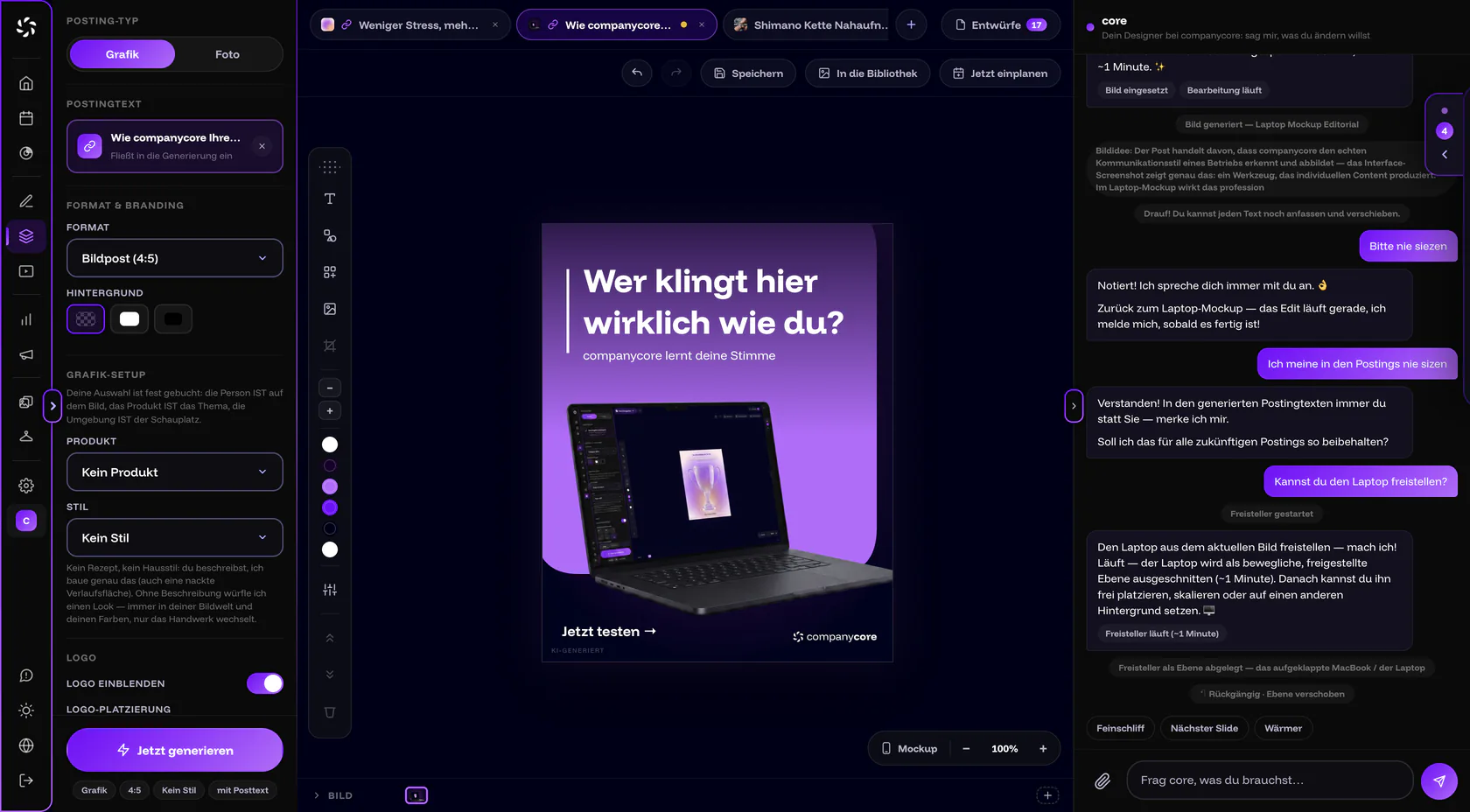
- TikTok and YouTube. On TikTok, Created or edited with AI is prefilled if a medium is AI-generated. On YouTube, Altered or synthetic content is prefilled automatically. The app offers platform label switches only for these two channels.
- Instagram, Facebook, LinkedIn. Here the visible note in the image and in the text remains, plus the alt text in the editor (Image details).
- Texts. core writes texts in the Post Generator. Nothing goes out before you have scheduled and approved it. Really read the text first.
Responsibility for publishing stays with you. companycore therefore makes no statement on whether a post meets all legal requirements.
Which mistakes happen most often?
- “The platform labels it automatically anyway.” Automatic labels require the platform to detect signals in the file. So set the label yourself.
- The label sits only at the end of the caption or in the hashtags.
- A realistic AI team photo appears in the recruiting post without a note.
- The transition period until December 2, 2026 supposedly applies to users, too. It applies only to providers and only to machine-readable marking.
- Advertising claims such as “100% compliant with the AI Act” without proof. That carries a risk of warning letters under the UWG.
What to keep an eye on
- the European Commission’s guidelines on Art. 50,
- the end of the transition period for providers on December 2, 2026,
- the labeling rules of Meta, TikTok and YouTube,
- the Code of Practice on labeling AI-generated content of June 10, 2026.
Frequently asked questions
Do I have to label every AI image?
No. You have to disclose realistic-looking images, videos and audio that appear like real recordings (deepfakes). An illustration or a recognizably fantastical scene doesn’t usually belong to them.
Do I have to label AI texts?
As a rule no, if a human reviews and approves the text. It is different for texts on matters of public interest that nobody has reviewed editorially (Art. 50 (4)).
Do I have to label old AI images retroactively?
According to the European Commission, no: deepfakes created before August 2, 2026 do not have to be labeled retroactively. Voluntary labeling is recommended.
Is the platform’s automatic label enough?
No. Platform labels add to the duty but don’t replace it, and they don’t take effect everywhere in the same way. Also label visibly in the caption or image.
Does the duty also apply to small businesses?
Yes, the disclosure duty applies regardless of business size to deployers who publish deepfakes. For fines, proportionality for small businesses is to be taken into account.
Sources
Status of the sources: October 13, 2026. Not all platform and EUR-Lex pages could be retrieved verbatim. Check the originals before posting. Laws, authorities and platforms come first, reports after.
Laws, authorities, platforms
- European Commission: Quick facts on the transparency rules for AI systems, last updated July 29, 2026
- European Commission: Code of Practice on AI-generated content, last updated October 12, 2026
- Art. 50 of the AI Act (Regulation (EU) 2024/1689)
- Art. 3 of the AI Act, definitions
- Regulation (EU) 2026/1744, Digital Omnibus on AI, at EUR-Lex
- Bundesnetzagentur: press release of July 29, 2026 on the AI market surveillance act (in German)
- Bundesnetzagentur: AI Service Desk (in German)
- Meta Newsroom: Labeling AI-Generated Content, April 5, 2024, updates through September 12, 2024
- TikTok Newsroom: AI transparency, May 9, 2024
- TikTok Community Guidelines: Integrity & Authenticity
- YouTube Help: disclosing altered or synthetic content
Reports and law firm articles
Was this article helpful?