

How to write hooks, captions and CTAs: with templates
Whether someone keeps reading is decided by the first line: on Instagram, only about 125 characters are visible before the “more” (guideline). A good post therefore has a hook, a benefit and a clear call to action. Here you’ll find 30 hook formulas, a caption structure and CTA templates.
As of October 13, 2026
The character windows below are guideline values, as companycore shows them in the editor. The help pages of the platforms we checked give no fixed number for them. All examples on this page are made up. Changes: October 13, 2026 – first version. Next review: January 2027.
Why does the first line decide?
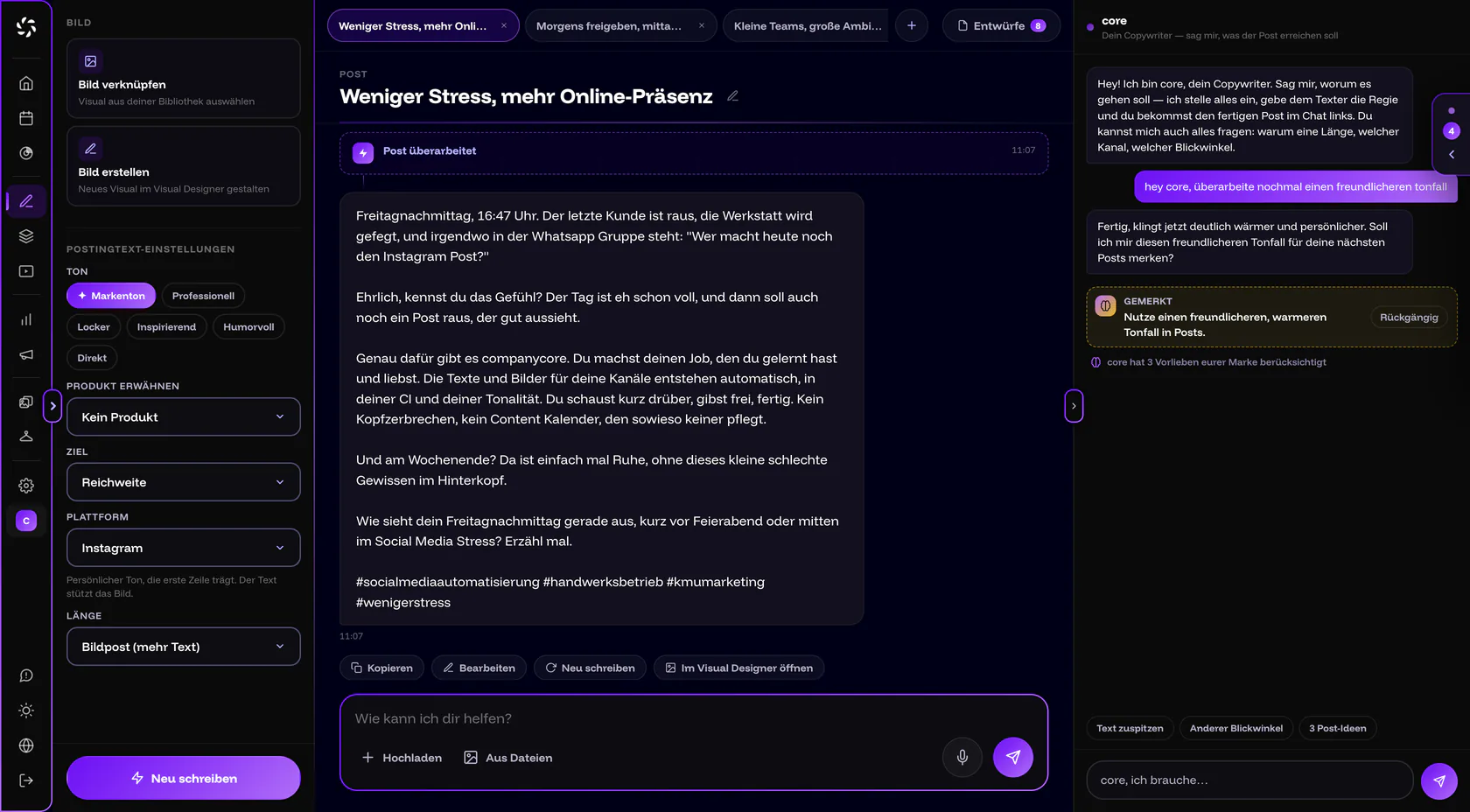
Feed and Reels show only the beginning of a text, followed by “more”. If people don’t tap there, they don’t read the rest. That’s why the Post Generator shows you Visible before “more” with the character count and marks the cutoff in the text.
| Platform | Guideline | What belongs in this line |
|---|---|---|
| about 125 characters | The hook and the start of the benefit, one or two short sentences. | |
| about 140 characters (mobile) | The core message. If people don’t get it, they won’t expand the rest. | |
| about 400 characters | Hook and context. This is where there is the most room. | |
| TikTok | about 125 characters | A hook in keywords. The video carries the content. |
| YouTube | about 40 characters | The title (up to 100 characters) carries the search. Of the description, only a little is visible at first. |
On top of that, the platforms measure whether people stick around. On Instagram, watch time is one of the three most important signals, alongside likes and sends (Adam Mosseri, January 22, 2025, according to Social Media Today). For YouTube Shorts, among other things, the share of viewers who watch a Short instead of swiping away counts (YouTube Help, retrieved October 13, 2026). LinkedIn’s help names dwell time and whether a post offers knowledge or advice (LinkedIn Help, retrieved October 13, 2026). So the beginning decides whether someone stays.
30 hook formulas with examples
A hook is the first line of a post, in a video the first seconds. It says what’s coming and why it’s worth reading on. The formulas are sorted by intent. Don’t use the examples word for word; replace them with a case from your business.
Mistakes, warnings and myths
| Formula | Pattern | Example |
|---|---|---|
| Mistake hook | “This mistake costs you …” | “This mistake costs you heating money every winter.” |
| Warning | “Stop …” | “Stop mopping your parquet with too much water.” |
| Nobody tells you | “What no … tells you” | “What no hairdresser tells you about bleaching.” |
| Myth | “‘…’ Not true.” | “‘Short hair is easier to care for.’ Only half true.” |
| Consequence | “If you don’t …, then …” | “If you don’t change the filter, you’ll pay for it in January.” |
| Unpopular opinion | “Unpopular opinion: …” | “Unpopular opinion: a wedding menu doesn’t need five courses.” |
Numbers and results
| Formula | Pattern | Example |
|---|---|---|
| Number hook | “Three things that …” | “Three things we clarify before every bathroom renovation.” |
| Result first | “[Result]. Here’s how.” | “A storage room became a bathroom. Here’s how.” |
| Time frame | “In … minutes …” | “An office broom-clean in 90 minutes: how it works.” |
| Before and after | “Before: … After: …” | “Before: dull and yellow. After: blonde that looks like vacation.” |
| Checklist | “Checklist: …” | “Checklist for apartment handover: what the property manager checks.” |
| Ranking | “Top 3: …” | “Our three best-selling breads this fall. Number 1 will surprise you.” |
Questions and curiosity
| Formula | Pattern | Example |
|---|---|---|
| Question to the audience | “Know the feeling? …” | “Know the feeling? You come home and the drain smells.” |
| Either-or | “A or B?” | “Gas or heat pump? It depends on three things.” |
| Did you know | “Did you know that …?” | “Did you know we roast our coffee ourselves?” |
| Open loop | “This is what happens when …” | “This is what happens when you don’t have a carpet cleaned for eight years.” |
| Direct address | “Looking for …?” | “Looking for a heating service appointment? One slot is still open this week.” |
| Why question | “Why …?” | “Why is bakery bread more expensive? The math in three lines.” |
Story and closeness
| Formula | Pattern | Example |
|---|---|---|
| Scene | “Tuesday, 6:50 a.m. …” | “Tuesday, 6:50 a.m. The first dough is already in the oven.” |
| Customer story | “Mr. M. called because …” | “Mr. M. called because his faucet had been dripping for weeks. The cause was something else.” |
| Confession | “Honestly: …” | “Honestly: this recipe completely failed on our first try.” |
| Behind the scenes | “This is what … really looks like” | “This is what building cleaning really looks like at half past one at night.” |
| Looking back | “What I wish I had known as a …” | “What I wish I had known earlier as an apprentice.” |
| Occasion | “… ago today we …” | “Ten years ago today we opened the workshop.” |
Price, offer and action
| Formula | Pattern | Example |
|---|---|---|
| Price hook | “What does … cost?” | “What does a facade cleaning cost? An example with a price.” |
| Few slots left | “Only … left” | “Three appointments are still free this week.” |
| Season | “Before … comes: …” | “Before the first frost comes: check these pipes now.” |
| New | “New here: …” | “New here: a lunch special with a menu that changes weekly.” |
| Answer to a question | “You ask, we answer: …” | “You ask: how long does a manicure last? Here’s the answer.” |
| How-to | “Here’s how: …” | “How to remove limescale from a shower wall without scratching it.” |
Deliver on your hook
A hook is a promise, and the post has to keep it. “Nobody tells you this” without a real answer costs trust. And don’t use the same formula three times in a row: by the third post, people recognize the pattern.
How do you structure a caption?
- Start with the hook. The first line must work on its own and sit before the “more”.
- State the benefit or tell the story. What does the reader get out of it? One to three short paragraphs are enough.
- Give proof. An example, a number from your business, a customer quote. Without proof, the benefit stays a claim.
- Add a call to action. Exactly one: call, write, save or share.
- Work in search terms in plain language. Service and place, for example “balayage in Cologne-Ehrenfeld”. Why that does more than hashtag lists is explained in Hashtags in 2026.
- Finish with 5 hashtags at most. Instagram has not allowed more since December 2025 (Instagram Help, retrieved October 13, 2026; introduction according to Social Media Today, December 18, 2025).
CTA library: calls to action by goal
A call to action (CTA) tells the reader what to do next. Pick one per post, matching your goal.
| Goal | Wording | Good to know |
|---|---|---|
| Call | “Call us. The number is in our bio.” | Fits emergency services and time-sensitive appointments. |
| Appointment | “Book an appointment: link in bio.” | Links in the post text are usually not clickable on Instagram, TikTok and YouTube. Mosseri denied in July 2025 that “link in bio” in the text lowers reach (PetaPixel, July 25, 2025). |
| Message | “Message us ‘quote’.” | One keyword makes replies easier for you to sort. |
| Save | “Save the checklist for spring cleaning.” | Fits carousels with checklists and how-tos. |
| Share | “Send this to someone who’s renovating right now.” | Sends, meaning forwards via direct message, are among the three most important signals on Instagram (Mosseri, January 22, 2025). |
| Comment | “A or B? Tell us in the comments.” | A question with two answers is easier to answer than an open one. |
| Apply | “Interested in an apprenticeship? Message us on WhatsApp.” | Without a cover letter and resume, the hurdle is lower. |
| Visit | “Come by: Tuesday to Saturday from 9 a.m.” | Opening hours and address belong in the text, not just in the profile. |
Informal or formal address, emojis, length: how do you decide?
Informal (du) or formal (Sie) address: Decide based on your customers and stick with it. Salons, cafés and shops often use the informal du with their guests; businesses with commercial clients and property managers use the formal Sie or word things neutrally. In companycore, you set this under Backstage › CI Overview in the Tone of voice card: Address (Du or Sie) and Who speaks (I, We or Neutral).
Emojis: Use them as structure, not decoration, for example one emoji at the start of a paragraph or list. Screen readers often read emojis out one by one, so several in a row are disruptive. In the Post Generator, you insert them via the Text tools.
Length: In the Post Generator, you pick a format per platform under Length. For Instagram these are Image post (more text), Reel (short & punchy) and Video; for LinkedIn and Facebook Short (~50 words), Medium (~90 words) and Long (~150 words); for TikTok and YouTube Short (~50 words) and Medium (~90 words). The length is a guideline, not a hard limit.
How do the platforms differ?
| Platform | Note in the Post Generator | Good to know |
|---|---|---|
| “Personal tone, the first line carries. The text supports the image.” | Via the API up to 2,200 characters (Meta for Developers). Links in the text are usually not clickable; Meta began testing clickable links for Meta Verified subscribers in March 2026 (PetaPixel, March 16, 2026); we haven’t checked how far that has rolled out since. | |
| “Matter-of-fact structure, strong opener, paragraphs instead of a wall of text.” | Up to 3,000 characters (LinkedIn Help). LinkedIn names whether a post offers knowledge or advice as a signal. According to a LinkedIn employee in the Buffer interview (December 19, 2025), a link needs accompanying text that adds value. | |
| “Approachable and conversational, kept short, no link clutter.” | From December 2025, Meta tested letting pages without Meta Verified publish only 2 link posts per month. The number varied (TechCrunch, December 17, 2025). | |
| TikTok | “A quick hook in the first line, few hashtags, a casual tone.” | Text up to 2,200 characters, and for photo posts an additional title up to 90 characters (TikTok for Developers). Links in the text are usually not clickable. |
| YouTube Shorts | “The title carries the search, the description explains what it’s about in a sentence or two.” | Title up to 100 characters, description up to 5,000 bytes (YouTube Data API). |
Bold and italic? Better not
Some tools convert text into characters that look like bold or italic. Those are special characters, not real formatting. Screen readers often don’t read them out, or read them letter by letter, and search doesn’t recognize the words as normal text. That’s why the Post Generator offers neither bold nor italic and says: “Platforms do not support bold/italic — this will be published as plain text.” For structure, emojis, •, → and ✓ work well.
Before and after: 5 captions compared
Five made-up examples, each with the weak and the stronger version. The stronger one is concrete, names a benefit and ends in exactly one action.
| Business | Weak | Stronger | What changes |
|---|---|---|---|
| Hairdresser, Instagram | “New look for our client! ✨ We’re thrilled with the great result. #hairdresser #hair #style” | “From yellow tint to cool blonde, without hurting the ends. It took three and a half hours in two steps. Want to go blonde too? Message us, we’ll advise you beforehand. #bleaching” | A concrete result instead of a mood, a benefit, one action. |
| Roofer, Facebook | “Another roof done. Thanks to the team!” | “Roof from 1968, new insulation, two weeks of construction. Before and after in the pictures. Is your roof older too? Message us for an inspection appointment.” | Numbers and a reason for the reader to act. |
| Café, Instagram | “Delicious lunch special again today! 😋” | “Today: pumpkin soup with ginger (vegan), schnitzel with potato salad, lentil dal. 11:30 a.m. to 2 p.m., from €9.80. Reserve by message.” | The offer is in the text, not just in the picture. Price and time are clear immediately. |
| Cleaning company, LinkedIn | “We are your competent partner for building cleaning.” | “One office building, 40 workstations, three night shifts a week: this is what our cleaning plan looks like. What belongs in yours, we’ll discuss in a short call.” | Proof from practice instead of self-praise. |
| Clothing store, Instagram | “New stock is here! Come by.” | “The winter jackets are here: 14 models from size 104. Three of them were gone on day one, you can see them in the carousel. Open Tuesday to Saturday.” | A concrete number, a detail that makes people keep swiping, clear opening hours. |
With companycore
In the Post Generator, Visible before “more” shows how much of your first line stays readable. With the quick actions Proofread, Tighten the copy and Different angle, core revises your draft; it remembers favorite phrasings and no-gos when you ask (“remember: …”) in core memory. You should still check the hook yourself, because only you know the case you just solved.
Frequently asked questions
How long should an Instagram caption be?
That depends on your goal. What matters is that the first line works on its own. Via the API, Instagram allows up to 2,200 characters (Meta for Developers), and the Post Generator offers Image post (more text) and Reel (short & punchy) for Instagram.
Do links in the caption work?
On Instagram, TikTok and YouTube, usually not; there you point to the link in your bio. On LinkedIn and Facebook, links in the text are usually possible. For Facebook, Meta began a test with a limit on link posts in December 2025 (TechCrunch, December 17, 2025).
Should I use emojis?
Yes, in moderation and as structure. Use them sparingly for trades and business clients; for salons, cafés and shops, more is fine.
Informal or formal address in posts?
Go by your customers and don’t switch partway through a profile. In companycore you set Address (Du or Sie) once, and core sticks to it from then on.
Can core write hooks for me?
Yes, core writes drafts with an opening and a call to action. With Proofread, it checks the hook, opening, typical AI patterns and form of address. But the facts and the case behind them always come from you.
Sources
- Social Media Today: Instagram shares algorithm insights 2025, January 22, 2025 (trade press quoting Mosseri)
- YouTube Help: Search & discovery tips for Shorts, retrieved October 13, 2026 (primary source)
- LinkedIn Help: LinkedIn relevance, retrieved October 13, 2026 (primary source)
- LinkedIn Help: Create posts, retrieved October 13, 2026 (primary source)
- Instagram Help: Use hashtags on Instagram, retrieved October 13, 2026 (primary source)
- Social Media Today: Instagram Implements New Limits on Hashtag Use, December 18, 2025 (trade press)
- Meta for Developers: IG User Media Reference, retrieved October 13, 2026 (primary source)
- TikTok for Developers: Direct Post Reference, retrieved October 13, 2026 (primary source)
- YouTube Data API: Videos resource, retrieved October 13, 2026 (primary source)
- Buffer: How LinkedIn’s Algorithm Works, According to the LinkedIn Team, December 19, 2025 (interview, secondary source)
- TechCrunch: Facebook is testing a link-posting limit for professional accounts and pages, December 17, 2025 (trade press)
- PetaPixel: “Link in Bio” rumor not true, says Instagram chief, July 25, 2025 (trade press)
- PetaPixel: Instagram begins testing clickable links in post captions, March 16, 2026 (trade press)
Was this article helpful?