

Marketing for cleaning companies and building cleaning
Building cleaners have two target groups: business clients who want to see reliability, and employees looking for a good employer. For each of them you need different channels and different posts.
As of October 13, 2026
Figures and legal status describe the situation in October 2026 and are not legal advice. Changes: October 13, 2026 – first version. Next review: January 2027.
Two target groups, two routes
| Target group | Channels | What you show |
|---|---|---|
| Business clients, for example offices, medical practices or property managers | LinkedIn (company page and owner profile), plus a complete Google Business Profile | Certificates explained, quality control, training, anonymized reference properties, response times |
| Employees | Facebook, Instagram and TikTok, in several languages if needed | Teams at work, onboarding, working hours, job openings as a carousel |
On LinkedIn, according to Socialinsider (Benchmarks 2026, retrieved October 13, 2026), posts reach an engagement rate of 5.20% per follower, on Instagram 0.45% and on Facebook 0.15%. On LinkedIn, documents, meaning PDF carousels, perform best. The values depend on the measurement method; other providers arrive at other numbers. And engagement measures reactions, not orders.
LinkedIn names, among other signals, dwell time, topic and whether a post offers knowledge or advice (LinkedIn Help, retrieved October 13, 2026). That argues for expert posts rather than advertising. That is our assessment.
Company page or owner profile?
The page is the showcase and the place for job ads. Personal profiles often reach more people according to rules of thumb, but that isn’t proven: LinkedIn gives no official posting frequency for pages, and third-party sources report declining organic reach for company pages, without a primary source. A sensible division of labor: the page shows reference properties and open positions, and the owner explains on her profile how a job runs. In companycore you choose one target per brand, see Connect a LinkedIn profile or company page.
Building trust with business clients
Business clients above all want to see that someone works reliably. Here’s what you can show:
- Explain certificates. Don’t just show the seal; say in two sentences what it means for the customer and what it doesn’t.
- Make quality control visible. Inspection round, checklist per room, feedback to the customer.
- Show training. Machines, hygiene, occupational safety: who was trained when.
- Anonymize reference properties. “Office, [number] m², [industry], [city], since [year]”. You only name the customer with their permission.
- Name response times. Only if you keep them: “Reply to every inquiry within one business day.”
What you can show and what you can’t
Easy to show
- Before and after for window and deep cleaning. Same spot, same angle, same light.
- Machines in use. Scrubber-dryer, pressure washer, telescopic pole.
- The team at work. With the consent of the people.
- Methods and products explained. What you use for what, and why.
Hard to show: routine cleaning
Good routine cleaning (Unterhaltsreinigung, the regular upkeep cleaning of a building) goes unnoticed. You can still make it visible without showing the client:
- Checklists. A filled-in checklist, anonymized.
- Numbers. How many properties, how many cleaning hours per week, how many inspection rounds per month. They are your own numbers.
- Routines. What happens in an office building at 6 a.m. before the first employees arrive, with no client data in the picture.
- Quality log. How you document deviations and fix them.
In a client property: ask first
Don’t photograph people, screens, documents or company logos in client properties unless the client has agreed. Recognizable people generally have to consent (§ 22 KUG, the German law on the right to your own image). Screens and papers can show personal data or trade secrets. Get permission in writing beforehand, for example in the contract. This is not legal advice. More in Photos of employees and customers.
Finding staff through social media
- Short application without a cover letter. Name, phone number, preferred work location and time window are enough for first contact. A form on your website is better than direct messages, where you shouldn’t ask for sensitive data.
- Job openings as a carousel. Image 1: position and location. Image 2: tasks. Image 3: working hours and pay. Image 4: how to apply. Every job ad should include location, tasks, conditions, contact and ideally a salary range, with “(m/w/d)” (the German gender-neutral job-title suffix) in the title.
- Insights into teams. Who works at which property, how onboarding works, who the contact person is. With consent.
- In your teams’ languages. Also write job posts in the languages your team speaks.
- Social media plus job ad. For apprentices, the apprentice recruiting trends show that the concrete search mostly runs through search engines (64% in the 2025 trends, 69% via Google in the 2026 trends, according to Haufe, secondary source). For cleaning staff we have no numbers. Still, link every recruiting post to a job ad that Google can find.
- Facebook groups. Posting in groups isn’t possible through tools like companycore: Meta shut down the interface for groups in April 2024 (according to Agorapulse, secondary source). companycore publishes to Facebook pages.
5 sample LinkedIn posts
Replace text in square brackets with your details. According to LinkedIn employees, a link needs accompanying text that adds value (Buffer interview, December 19, 2025). LinkedIn has not confirmed an official penalty for external links.
- Quality made visible (document carousel). “This is how we check after every cleaning: 1. Checklist per room. 2. Spot check by the site manager. 3. Photo for deviations. 4. Feedback to you within [time]. What question do you have about our quality control?”
- Certificate explained. “We are certified to [standard]. For you, that means: [benefit in one sentence]. It doesn’t mean: [limit in one sentence]. I’m happy to answer questions about it.”
- Numbers from everyday work. “[Number] properties, [number] employees, [number] cleaning hours per week. This is how we build a staffing plan from that every week. Where it snags most often: [example].”
- The owner’s take (personal profile). “Three questions office managers ask us before the first cleaning, and my answers: [Question 1]. [Question 2]. [Question 3].”
- Job opening. “We’re looking for reinforcements for properties in [city]: [working hours], [pay], onboarding by [name or role]. Short application without a cover letter: [link].”
Weekly plan and 30 post ideas
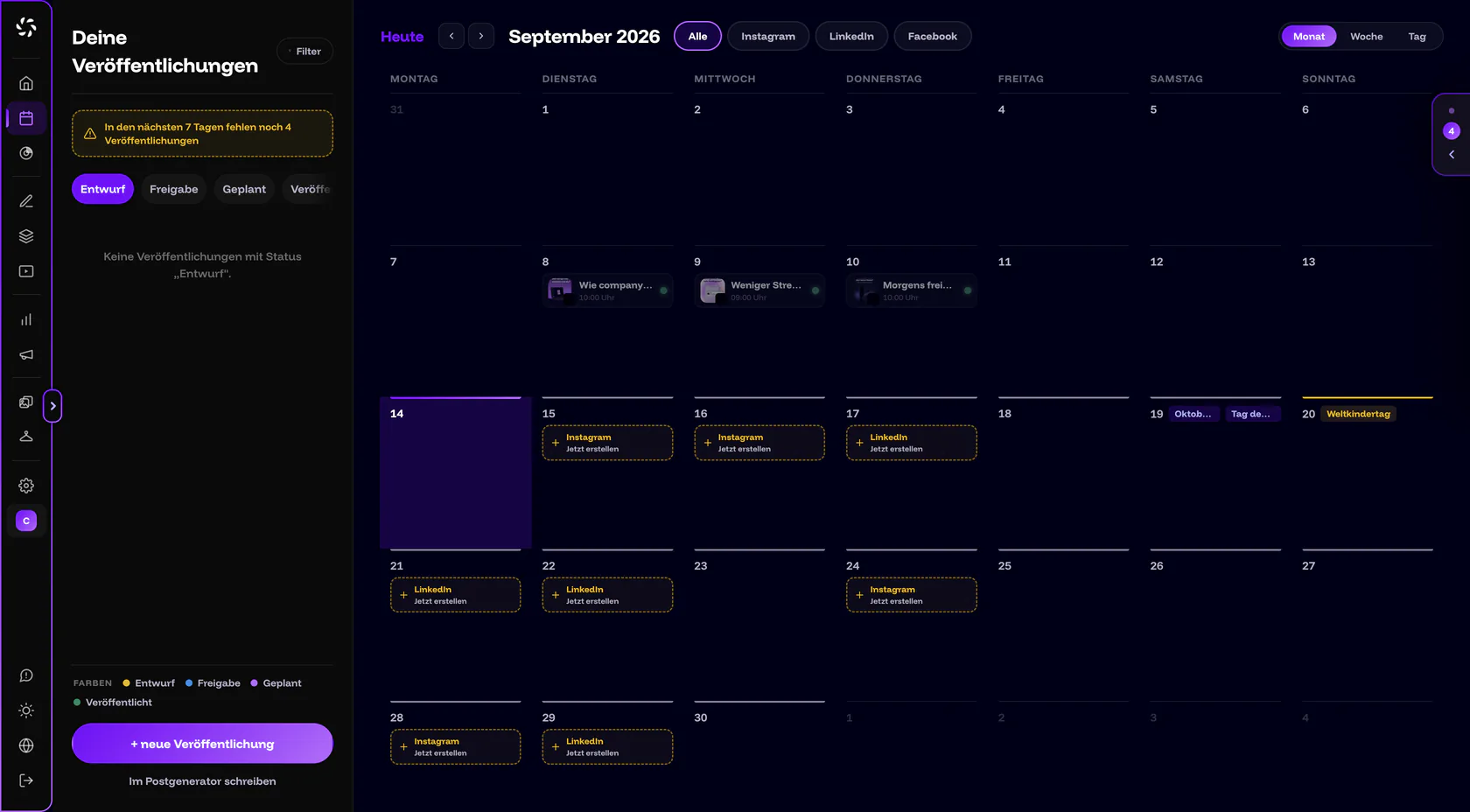
On LinkedIn, accounts that posted 2 to 5 times a week got more impressions per post than accounts with one post a week, according to Buffer (over 2 million posts, August 2025). That is a correlation, not a promise. A plan with three posts:
| Day | Post | What you need |
|---|---|---|
| Tuesday | LinkedIn: quality, certificate or numbers from everyday work | A photo or a document carousel |
| Thursday | Instagram and Facebook: team or a job on site, without client data | A photo with consent |
| Friday | Recruiting, alternating: job opening, onboarding or team story | One to four images |
Trust with business clients
- Certificate explained. What it means and what it doesn’t.
- Inspection round. How you check a property after cleaning.
- Training of the month. Who was trained on which topic.
- Reference property, anonymized. Type of property, size, since when.
- Response time. How fast you answer an inquiry, with a real example.
- Question before the contract starts. For example: who is the contact person if something is missing?
Making the work visible
- Before and after window cleaning. Same angle, same light.
- Deep cleaning in time-lapse. From the dirty surface to handover.
- Machine of the month. What it can do and what you use it for.
- Cleaning products explained. Why you use what on which surface.
- Avoiding damage. Which product doesn’t suit which floor.
- Early shift. What a property looks like before the office opens.
Numbers and everyday life
- The week in numbers. Properties, employees, cleaning hours.
- Staffing plan. How you plan a week and what comes up in between.
- Checklist as an image. A template for offices that want to keep things tidy themselves.
- Year in review. New properties, new employees, what you improved.
- Question of the week. A question from a client conversation with your answer.
- Seasonal tip. Spring cleaning or deep cleaning at year-end: when what pays off.
Finding staff
- Job opening as a carousel. Tasks, hours, pay, how to apply.
- Onboarding. A new colleague’s first three days, with consent.
- Introduce the contact person. Who helps new employees at the property.
- Work clothes and equipment. What you provide.
- Short application explained. Here’s how to apply without a cover letter.
- Employee voice. One sentence on why someone works for you, with consent.
Team and culture
- Team profile. Name, property, what the person likes about the work, with consent.
- Anniversary at the company. Five years on board.
- Team breakfast or summer party. One photo, one thank-you.
- Further training. Who earned which qualification.
- Thanks in several languages. In the languages spoken in the team.
- Thanks to a client. A property you’ve looked after for years, with the client’s consent.
With companycore
You connect your LinkedIn company page under Backstage › Connections and choose it as the Target profile. For a carousel on LinkedIn, you choose the format Document: 1 to 10 images become a PDF, one image per page. Several images without a PDF go out as a Feed post. As a product you create Service without a product, as an environment Office / workplace, and you save a recruiting series once as a template, for example with the keyword “job ad” (Carousels, slides and templates).
Frequently asked questions
Is LinkedIn worth it for a cleaning company?
If you want to win business clients, it is the most obvious of the five platforms; that is our assessment. According to Socialinsider 2026, posts there reached an engagement rate of 5.20% per follower, on Instagram 0.45%. Engagement is reactions, not orders.
Company page or personal profile?
Both have a role: the page shows references and jobs, the owner’s profile adds perspective. In companycore you choose one target per brand. For both you need two brands; multiple brands are available from the Pro plan.
Can I take photos in client properties?
Only with the client’s consent. No people, screens, documents or company logos without permission. This is not legal advice.
How do I find cleaning staff through social media?
Make yourself visible on Facebook, Instagram and TikTok, offer a short application without a cover letter and link every post to a job ad that Google can find. companycore can’t post in Facebook groups.
How do I show routine cleaning?
Through checklists, numbers, routines and logs instead of before-and-after images, with no client data in the picture.
Sources
- Socialinsider: Social Media Benchmarks 2026, retrieved October 13, 2026 (vendor study)
- LinkedIn Help: LinkedIn relevance, Optimizing the member experience, retrieved October 13, 2026 (primary source)
- LinkedIn Marketing Solutions: What is the optimal frequency of updates on a company page (#AskLMS) (primary source)
- LinkedIn Help: Share documents, retrieved October 13, 2026 (primary source)
- Buffer: How Often Should You Post on LinkedIn, August 28, 2025 (vendor study, correlation)
- Buffer: How LinkedIn’s Algorithm Works, According to the LinkedIn Team, December 19, 2025 (interview, secondary source)
- Haufe: Image and future of apprenticeships (apprentice recruiting trends 2025) (in German; secondary source)
- Haufe: Apprentice recruiting, how Generation Alpha looks for training positions (apprentice recruiting trends 2026) (in German; secondary source)
- Agorapulse Support: Facebook Groups Update, April 2024 (secondary source)
- § 22 KUG (German Art Copyright Act, right to your own image; in German; primary source)
Was this article helpful?