

Create social media posts with AI: how to do it well
AI writes drafts, variants and images in seconds. The result only gets good with your real facts, your photos and your review: you supply, the AI words it, you approve.
As of October 13, 2026
The legal section describes the situation as of October 2026 and is not legal advice. We will review it again in January 2027. Changes: October 13, 2026 – first version.
What is AI good at, and what isn’t it?
| Task | What AI can do | What stays with you |
|---|---|---|
| Writing a draft | Deliver a first text in seconds. | Supply the facts and check every statement. |
| Variants | Shorter, looser, a different opening, a different platform. | Choose the right version. |
| Image ideas and illustrations | Backgrounds, graphics, seasonal motifs. | Check that motif and brand fit. |
| Format adaptation | Rework an Instagram text for LinkedIn. | Know the tone and audience of the platform. |
| Real insights | Nothing; the AI wasn’t there. | Photos, examples and numbers from your business. |
| Relationship with customers | Nothing. | Replies, conversations, trust. |
| Responsibility | Nothing. | Prices, service promises and every statement in the post. |
The workflow: human supplies, AI words it, human approves
- Collect facts and photos. One sentence about the occasion, a real photo, proof such as price, time frame or result. Without that, every AI writes the same thing it writes for everyone else.
- Generate an AI draft. Include role, context, audience, format and tone (see the prompt formula below).
- Check and adjust. Do the numbers, names and services add up? Cut the clichés. Does the text sound like you?
- Approve. Only once you have read the text does it move on. That a person reviews and takes responsibility also matters legally (see below).
- Schedule. Set the date and choose the channels.
How do you avoid generic AI copy?
AI texts often sound alike because, without your input, they fall back on the obvious. The remedy is things only you have.
- Use your own numbers and examples. “Today we replaced 14 windows” instead of “We offer high-quality windows”.
- Use your own photos. Stock photos and AI photos look like a catalog; a phone photo from your workshop doesn’t.
- Define your tone. Informal du or formal Sie, I or we, sentence length, humor.
- Write down your dos and don’ts. What should never appear, for example em dashes, exclamation points or certain words.
- Cut typical AI clichés. Suspicious phrases are “In today’s fast-paced world”, “Dive into”, “Discover”, “unique”, “seamless” and “Whether you … or …”. Strings of em dashes and lists of three in every paragraph stand out as well.
- Check for repetition. Same sentence openings and same structure in every post? Then people read your profile as a series of the same template.
Instagram head Adam Mosseri wrote in his year-ahead outlook of December 31, 2025 that “authenticity is becoming infinitely reproducible”: authenticity can now be imitated convincingly. He considers it more promising to label real media than to chase fakes (Music Ally, January 5, 2026). Our assessment, not a platform rule: what can be verified remains your strongest argument, that is, your business, your customers and your work on real photos.
Prompts that work
A good prompt has six parts. With them you give a general AI chat such as ChatGPT what it can’t know about your business.
| Part | What goes in | Example |
|---|---|---|
| Role | Who should the AI be? | “You are a copywriter for a hair salon in [city].” |
| Context | Occasion, facts, what the photo shows | “From [date] we’re offering a new balayage technique that needs less maintenance.” |
| Audience | Who are you writing for? | “Women between 30 and 50 who have little time for upkeep.” |
| Format | Platform and length | “Instagram caption, at most 600 characters, first line under 125 characters.” |
| Tone | Du or Sie, style, no-gos | “Informal du address, casual, no emojis, no exclamation points.” |
| Example | An earlier text that went over well | “Write in the style of this text: […]” |
10 example prompts to adapt
Replace everything in square brackets with your own details.
- Before and after (trades): “Write an Instagram caption for a before-and-after photo: [service], [place], [duration], special problem: [problem]. Start with the result, not with a greeting. Informal du address, five hashtags at most.”
- Price example (hairdresser): “Write a post that explains what [service] costs with us and what the price includes: [items]. Matter-of-fact, no discount clichés, with a prompt to book an appointment.”
- Weekly menu (hospitality): “Turn this weekly menu into an Instagram caption: [dishes and prices]. Give times and how to reserve. Five lines at most.”
- FAQ answer (cleaning): “Answer the question [question] for property managers in three sentences. Give a concrete example and end with an offer to talk.”
- Job post (apprentice): “Write a post for an apprenticeship as [occupation] in [place]. Facts: [pay], [start], [what apprentices learn with us]. Address teenagers and their parents, without teen slang.”
- LinkedIn post (B2B): “Write a LinkedIn post about a completed project: [property], [period], [result]. Matter-of-fact, paragraphs instead of a wall of text, one question at the end.”
- Hook variants: “Give me ten variants for the first line of a post about [topic]. Each under 125 characters, no promises the post doesn’t keep.”
- Occasion post: “Write a post for [occasion, for example Mother’s Day] for [industry]. Offer: [offer], valid until [date]. Tone: [tone].”
- Shortening: “Shorten this text to 600 characters. Keep all numbers and names, cut clichés and exclamation points: [text]”
- Proofreading: “Read this post like a strict editor: where is the opening weak, which sentences sound like AI, what stays unclear? Don’t change anything, just list: [text]”
Don’t enter names, phone numbers or health details of customers into such prompts; more on that in the section on the law.
When do AI images make sense?
| Motif | Does an AI image make sense? | Why |
|---|---|---|
| Backgrounds and textures | Yes | They set a mood without claiming anything. |
| Illustrations and graphics (quote, checklist, number of the day) | Yes | It’s clearly recognizable as a graphic. |
| Seasonal motifs (fall leaves, Christmas decorations as a frame) | Yes | They illustrate, they don’t document anything. |
| Work results (before and after, finished room, hairstyle) | No, real photos only | An AI “result photo” shows work that never happened. |
| Team and employees | No, real photos only | Applicants and customers want to see the real people. |
| Dishes and products | No, real photos only | People who order expect what the photo shows. |
companycore’s Visual Designer sets a guardrail for this: it doesn’t generate invented people with recognizable faces. People come from your own photo or your Model.
What does the law say? The essentials in brief
Not legal advice
This section explains general rules for Germany and the EU, as of October 2026. It does not replace legal advice and does not assess any individual case. If you are unsure, a lawyer, your chamber of commerce (IHK) or your chamber of crafts (Handwerkskammer) can help.
- Label realistic AI images and videos. Article 50 of the EU AI Act (KI-VO) has applied since August 2, 2026. Deployers, meaning businesses that publish AI content professionally, must disclose deepfakes: realistic-looking image, audio or video content that resembles real people, places or events and could falsely appear authentic (European Commission, Quick Facts, updated July 29, 2026; Art. 3(60) AI Act). There is no blanket duty for every AI image. A graphic that is clearly recognizable as one generally doesn’t fall under it.
- AI texts with human review. Ordinary marketing texts that a person reviews and approves generally need no AI notice under Art. 50(4). A duty can exist for texts that inform the public on matters of public interest and that nobody has reviewed and taken responsibility for.
- Platforms require additional notices. TikTok requires a label for AI content with realistic-looking scenes or people (TikTok Community Guidelines, retrieved October 13, 2026). YouTube asks about realistic altered or synthetic content (YouTube Help, retrieved October 13, 2026). Meta requires disclosure for photorealistic videos and realistic-sounding audio and shows the label “AI info” (“KI-Info” in German) on detected AI content (Meta Newsroom, April 5, 2024, with updates through September 12, 2024).
- Logos and images. The Munich Local Court (Amtsgericht München) ruled on February 13, 2026 (142 C 9786/25) that purely AI-generated logos were not protected by copyright, even with detailed prompts (secondary source: beyer.law, March 20, 2026). You may then be unable to stop imitators. Whether this carries over to other images depends on the individual case. Using someone else’s material as a template, such as another party’s logo or photo, can on the other hand infringe rights.
- Don’t fake results. An AI image showing work you never did can be misleading under Section 5 of the German Unfair Competition Act (UWG), even with an AI notice. That is our reading of the law; we know of no court decision specifically on AI images in this context.
- No customer data in third-party AI tools. Don’t enter customers’ names, phone numbers or health details into an AI chat. For that you would generally need a legal basis and usually a data processing agreement with the provider.
You’ll find the details, with examples, in AI labeling requirement. How companycore labels images is explained in AI labeling in companycore.
With companycore
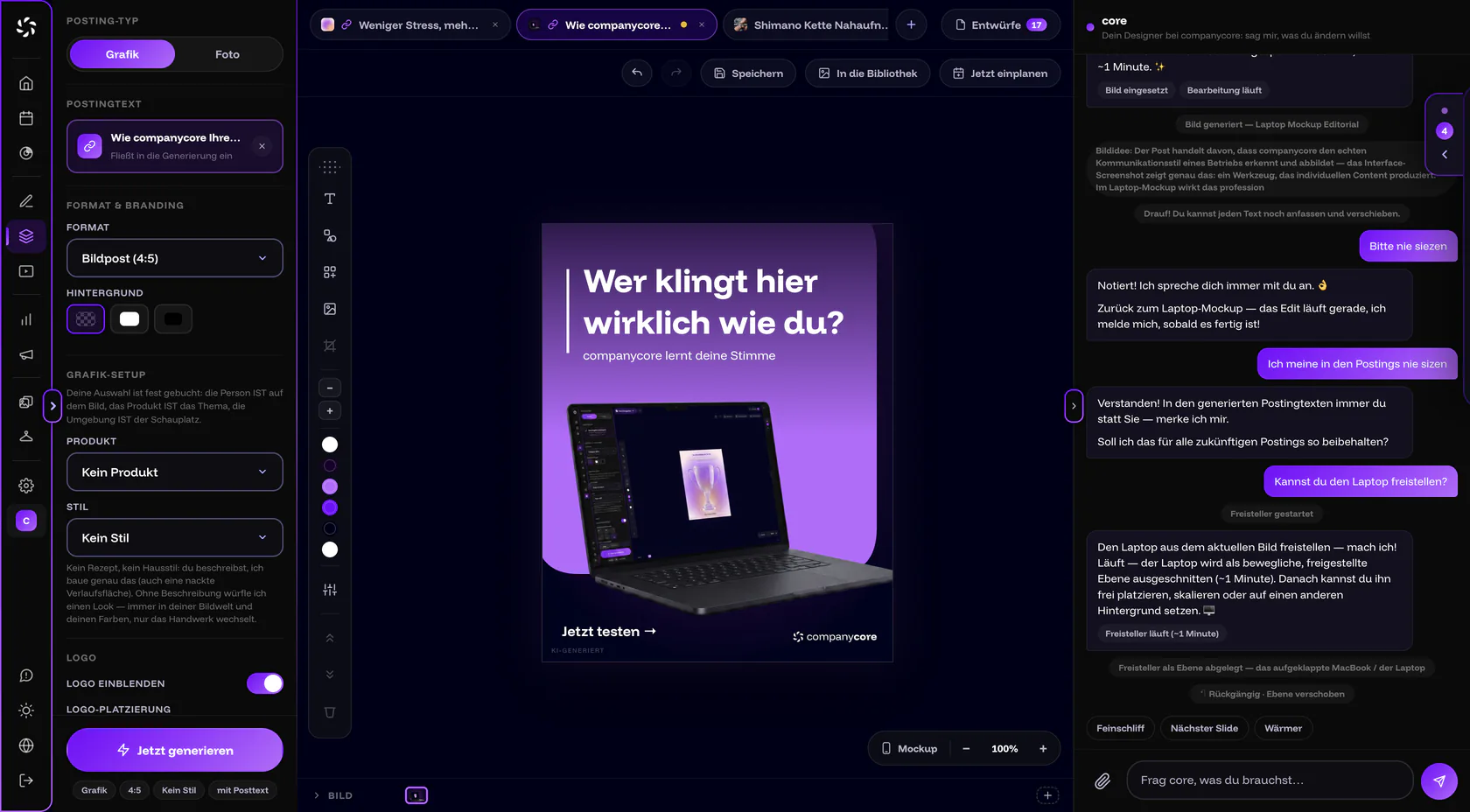
Instead of long prompts, companycore works with your brand analysis, your uploaded company content and core memory: you set tone, form of address and no-gos (“remember: no em dashes”) once, and the Post Generator takes them into account for every text. Images are created in the Visual Designer in your colors and fonts, text and logo remain editable layers, and an image that could pass as a real photograph gets a visible label. Nothing is published before you have scheduled it.
Frequently asked questions
Can you tell when a text is from AI?
Often, from the same clichés over and over, a uniform structure and missing details. With your own facts and a real review, you avoid that.
Do I have to label AI texts?
Generally not if a person reviews them and takes responsibility (Art. 50(4) AI Act). For images and videos, it depends on whether they look realistic. This is not legal advice; details are in AI labeling requirement.
Can I post AI images of my team?
Use real photos for your team and employees. A realistic AI team photo would generally have to be labeled, and it deceives applicants about your team.
Can I enter customer data into an AI chat?
Better not. Leave names, phone numbers and health details out of prompts. For personal data you generally need a legal basis and usually a data processing agreement.
Do I own an AI image?
Not necessarily. The Munich Local Court denied copyright protection to purely AI-generated logos, even with detailed prompts (February 13, 2026, according to a secondary source). The ruling concerns logos; whether it carries over to other images depends on the individual case.
Sources
- European Commission: Quick Facts, Transparency rules for AI systems, last updated July 29, 2026 (primary source)
- Regulation (EU) 2024/1689, Art. 50 and Art. 3, regulation text via artificialintelligenceact.eu, retrieved October 13, 2026 (primary source)
- Meta Newsroom: Labeling AI-Generated Content, April 5, 2024, with updates through September 12, 2024 (primary source)
- TikTok Community Guidelines: Integrity and Authenticity, retrieved October 13, 2026 (primary source)
- YouTube Help: Disclosing altered or synthetic content, retrieved October 13, 2026 (primary source)
- beyer.law: Copyright in AI logos, Munich Local Court denies protection despite detailed prompts (in German), March 20, 2026 (secondary source)
- Music Ally: Instagram boss, authenticity is becoming infinitely reproducible, January 5, 2026 (trade press on Adam Mosseri’s year-ahead outlook of December 31, 2025)
Was this article helpful?